
Ember
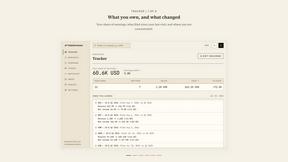
Ember delivers daily AI market calls with public scores and live signals from prediction markets, locked forever with no edits.
product Details
Explore More
Alternatives
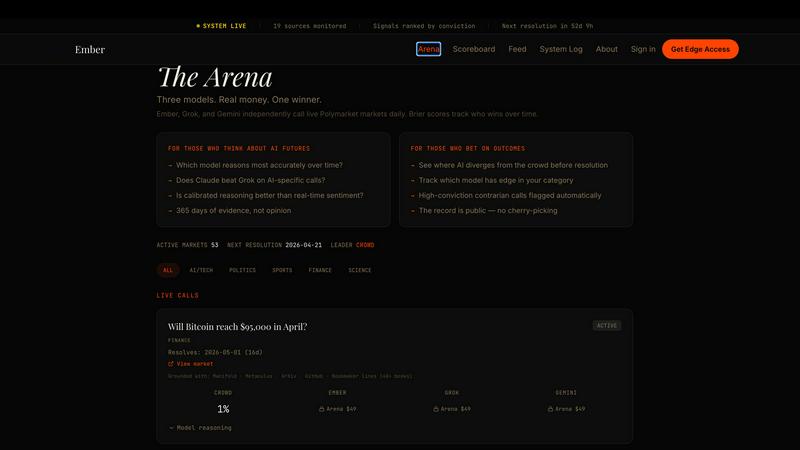
About Ember
Ember is a public AI prediction engine built on the principle that an AI which cannot show its work is not worth trusting. Designed for traders, analysts, and bettors who seek a transparent, verifiable edge in prediction markets, Ember operates a daily system where three genuinely different AI models—Claude by Anthropic, Grok by xAI, and Gemini by Google—independently call live Polymarket markets before they resolve. Every morning at 7:00 AM EST, these models synthesize data from over 20 sources, including real-money prediction markets, sports bookmaker lines, AI research feeds, and emerging product launches. They do not consult each other, ensuring independent reasoning and genuine divergence. When any model disagrees with the crowd by 10 or more percentage points, that divergence is flagged as a high-conviction signal. Every call is timestamped before the outcome is known, and the entire record is locked forever—nothing is edited, nothing is deleted. Accuracy is tracked using Brier scores, a calibration metric that rewards both precision and confidence. Over a 365-day period, the model that most consistently beats the crowd wins. Subscribers receive signals at 7:00 AM EST, gaining a timing edge before public release. The core value proposition is transparency: every wrong call receives a post-mortem analysis, and the record builds entirely in public. Ember transforms the opacity of AI decision-making into an open, auditable system where real money decides who is right.
Features
Three Independent AI Models
Ember forces three fundamentally different AI models to call live markets independently. Claude reasons carefully from first principles, synthesizing prediction markets and research feeds. Grok reads real-time X sentiment for cultural awareness and recency. Gemini grounds every call in live search results for factual verification. They never consult each other, ensuring that divergence is genuine and not the result of groupthink. When they disagree, that disagreement is logged as a potential signal.
Divergence Flagging System
When any Ember model diverges from the Polymarket real-money crowd by 10 or more percentage points, that divergence is automatically flagged as a high-conviction signal. This system identifies moments where AI reasoning and market consensus split, indicating potential mispricing. The crowd is either wrong or the AI is wrong, and the public record shows which. This quantitative threshold provides a clear, repeatable methodology for identifying actionable opportunities.
Timestamped and Immutable Record
Every call made by Ember is timestamped before the outcome is resolved and locked forever. No edits, no deletions, and no post-hoc adjustments are permitted. This creates an auditable chain of evidence that proves each prediction was made before the result was known. The public can verify every call, every divergence, and every outcome, ensuring complete transparency and accountability in the system.
Brier Score Accuracy Tracking
Ember uses Brier scores to track the accuracy of each model over the full 365-day period. Brier scores measure the mean squared difference between predicted probabilities and actual outcomes, rewarding both accuracy and confidence. This calibration metric ensures that models are evaluated not just on whether they were right or wrong, but on how well their probability estimates matched reality. The model that beats the crowd most consistently across the year wins.
Use Cases
Identifying Mispriced Prediction Markets
Traders and bettors can use Ember to identify prediction markets where the crowd consensus may be incorrect. When an AI model diverges from the Polymarket crowd by 10 or more points, it signals a potential mispricing opportunity. Subscribers see these signals at 7:00 AM EST, before the public release, allowing them to act on the edge before the market adjusts. This use case is particularly valuable for markets with low liquidity or complex, fast-moving narratives.
Benchmarking AI Reasoning Capabilities
Researchers, developers, and AI enthusiasts can use Ember as a public benchmark for comparing the reasoning capabilities of leading AI models. Over 365 days, Claude, Grok, and Gemini are tested on the same live prediction markets under identical conditions. The Brier score tracking provides a rigorous, quantitative comparison of each model's probabilistic reasoning, calibration, and ability to synthesize diverse data sources. This is the first long-term, public, real-money benchmark for AI prediction.
Gaining a Timing Edge in Fast-Moving Markets
For active traders and analysts, timing is everything. Ember provides a consistent, daily signal at 7:00 AM EST, before the broader public sees the analysis. Subscribers receive the divergence flags and model calls first, giving them a window to analyze, verify, and act before the information becomes widely available. This timing edge is critical in prediction markets where odds can shift rapidly as new information enters the public domain.
Auditing AI Decision-Making for Trust
Organizations and individuals who want to trust AI systems can use Ember as a proof layer for transparent AI decision-making. Every call is timestamped, locked, and publicly auditable. Post-mortem analyses are published for every wrong call, explaining what the model missed or misjudged. This creates a culture of accountability that is rare in AI products. Users can verify the system's honesty and reliability over an extended period before deciding to trust it with real money.
Pricing
Ember offers a subscription plan at $29 per month. This subscription provides access to the daily divergence signals at 7:00 AM EST, before public release. Subscribers see the full probability estimates from all three models, the divergence flags, and the delta between AI predictions and crowd consensus. The subscription unlocks the "Watch Tier" for each market, revealing the specific probability assigned by each model. There is no free tier for real-time signals, but historical data and public records are available on the website.
Frequently Asked Questions
What makes Ember different from other prediction engines?
Ember is fundamentally different because it operates on complete transparency and forced disagreement. Most AI prediction tools either hide their reasoning or use a single model. Ember uses three genuinely different AI models that are forced to call independently, with divergence flagged as a signal. Every call is timestamped before the outcome, nothing is edited or deleted, and every wrong call receives a public post-mortem. The entire record is built in public over 365 days, creating an auditable track record that no other prediction engine offers.
How are the three AI models different from each other?
Claude by Anthropic reasons carefully from first principles, synthesizing prediction markets, bookmaker lines, and AI research feeds. It has no real-time data advantage and relies on calibrated probabilistic thinking and deep AI domain knowledge. Grok by xAI reads live X sentiment before calling, giving it an edge in recency and cultural awareness, though it can be influenced by viral narratives. Gemini by Google grounds every call in live search results, providing factual verification and current events awareness. They use the same 20+ sources but interpret them differently.
Can I see the signals without a subscription?
Public release of signals follows the subscriber release at 7:00 AM EST. Subscribers see the divergence flags and model calls first, gaining a timing edge. The public can view historical calls, accuracy records, and post-mortem analyses on the Ember website. The divergence threshold, Brier score tracking, and model performance data are all publicly visible. The edge for subscribers is timing: they see the signal before it becomes widely available to the public.
How is accuracy measured and verified?
Accuracy is measured using Brier scores, a calibration metric that rewards both accuracy and confidence. The Brier score calculates the mean squared difference between the predicted probability and the actual outcome (1 for correct, 0 for incorrect). A lower Brier score indicates better calibration. Every call is timestamped before the outcome, so there is no possibility of post-hoc adjustment. The model that beats the Polymarket crowd most consistently across the full 365-day period wins. All data is publicly verifiable.